
Execution Gaps #23: The Friction That Never Generates an Escalation
Why the most expensive problems in your operation aren't the ones that break loudly.

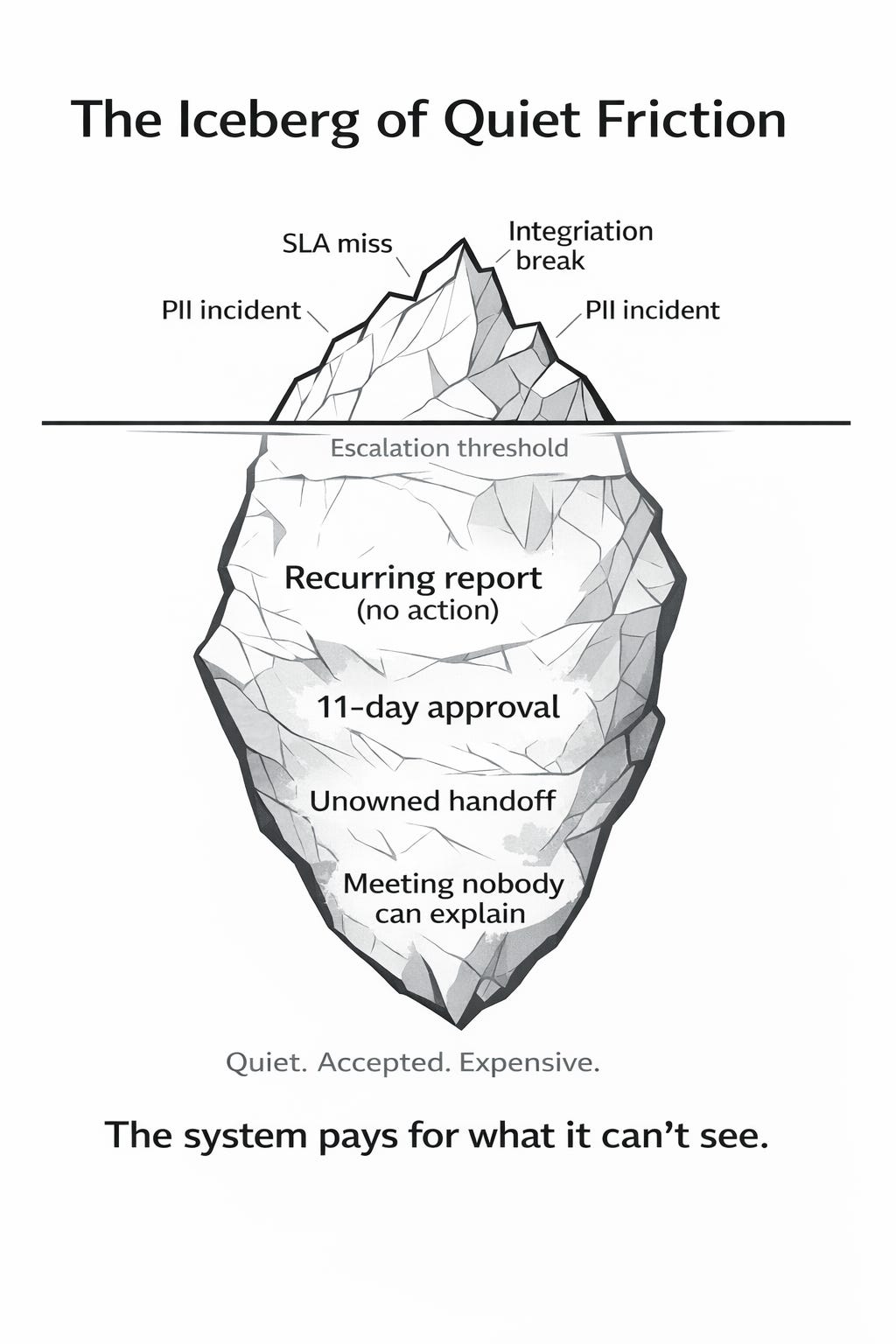
An SLA miss gets a meeting within 48 hours. An integration that breaks on day one gets an incident report, a war room, three executives on a call. A device shipped with personal data still on it: Legal is in the room before lunch.
These are the problems everyone knows how to respond to. They’re visible, they’re urgent, and they generate escalation by design. The system has antibodies for them.
But the problems that actually cost you the most? They don’t look like problems at all. They look like the normal pace of your operation.
I’m talking about the five-minute email that happens 200 times a quarter. The approval that everyone thinks takes a day but actually takes eleven. The report that takes a team three days to produce every month, gets sent to forty people, and generates exactly zero action. The handoff where one team’s output lands on another team’s desk and sits for a week because nobody explicitly owns the transition, but nobody’s complaining either because that’s just how long it takes.
Quiet friction. The background rate of your operation. And because it never triggers an escalation, it never triggers a fix.
I’ll come back to why that last part is the expensive one. But first, a story.
At TXU Energy (the largest competitive retail electricity provider in the US at the time, in a deregulated market), there was a monthly report on customer complaints. It tracked volume, categories, trends. It went out to a significant distribution list: operations, billing, sales, and their leadership. It had been running for years. Well over a decade, as far as I could tell.
The report was thorough. The numbers were accurate. And it was completely useless.
Not because the data was wrong. Because the report stated symptoms without ever diagnosing causes. Complaints were up in billing? The report would tell you that. Why they were up, what was structurally broken, which handoff or process gap was generating the volume: none of that. Just numbers, month after month, year after year. A perfectly produced document that described the fever without ever looking for the infection.
And here’s what made it genuinely costly (beyond the time spent producing it): the report’s existence gave the entire organization permission to assume someone was acting on the problems. “Oh, so-and-so’s got it.” Except nobody had it. Nobody was tracing complaints back to root cause. Nobody was asking the five whys. The complaints team reported on issues. Operations, Billing, and Sales each focused on their own jobs. The seam between “this keeps happening” and “here’s why, and here’s who needs to change what” belonged to nobody.
For more than ten years!!!
That’s quiet friction at its most insidious: not wasted effort in the obvious sense (though the report production itself wasn’t cheap), but the way the friction actively prevented the system from learning. The report was organizational cover masquerading as a diagnostic tool. It absorbed the energy and attention that should have gone into actual root cause analysis, and redirected it into a monthly ritual that made everyone feel informed without anyone being accountable.
Eventually, the COO unilaterally promoted/dropped me into that team with a specific mandate: figure out the actual issues so someone could address and fix them. Which sounds great until you realize that uncovering the actual issues means uncovering where the actual breakdowns live. And breakdowns live in people’s teams.
The VP of Operations (who had been trying to find me a role in his group just weeks earlier, by the way) was not thrilled. From his perspective, my presence meant two things: first, I was being paid to air his team’s dirty laundry directly to his boss. Second, I was a cost on his P&L with zero compensation. Not “I increased his budget” in the useful sense. I increased his expenses, and the only return on that investment was someone uncovering problems he’d rather solve quietly, if at all. To be clear, I don’t think he was even thinking of me as an adversary. I was a brand-new manager. He ran by far the largest team and budget in the company. There were two guys between us in the org chart. I was basically a fly in his ointment.
I was too focused on the problem to read the room. Classic mistake. I had the COO’s cover, so I put my head down and did the work. Then the COO left the company.
And I was exposed. No air cover, a VP who had every reason to want me gone, and a mandate nobody remembered authorizing. This was months after I’d won a company-wide recognition for a different program. Didn’t matter. I came very close to being fired.
That experience taught me something I’ve carried ever since: quiet friction is politically dangerous to fix precisely because nobody wants to admit it existed for a decade. The report wasn’t just wasted effort. It was a load-bearing piece of the organization’s self-image. Everyone had agreed, implicitly, that the report meant the problem was being managed. Proving otherwise wasn’t a technical contribution. It was a threat.
Let’s step back and look at the pattern, because this definitely isn’t just a TXU story.
I’ve written before about what breaks at the handoff: role fog, trigger drift, recovery tax. Those three failure modes share a common feature. They’re all quiet. No single handoff is broken enough to generate a meeting. No single team is failing its own KPIs. The damage accumulates in the seams between functions, where one team’s output becomes another team’s input and nobody has explicitly designed that transition.
In a program I advised on (I wrote about it in that same issue), four teams were each hitting their targets: Purchase was sourcing at target cost, Processing was hitting throughput, Pick/Pack/Ship was clearing the floor, and Sales had won the buy box on a major marketplace. Every function looked green in its own review. Yet the company was hemorrhaging cash. No one escalated because there was nothing to escalate. Each team’s metrics said things were working. The full-arc economics said otherwise, but the leadership structure hadn’t created a role (or a reflex) for someone to look across all four functions and ask whether the whole thing actually made money.
The pattern is the same one from TXU, just operating at the inter-functional level instead of the reporting level. Quiet friction doesn’t create incidents. It creates a background rate that the organization slowly accepts as reality. “That’s just how long it takes.” “That’s just how the process works.” Nobody questions it because there’s no trigger to question it. The absence of escalation becomes proof that things are fine.
Two operating principles intersect here, and the intersection is where (I believe) the most recoverable value hides.
The first is what we call flow integrity at TICE (one of five principles we use): the idea that execution breaks not inside functions but at the seams between them. Quiet friction lives at those seams. The handoff nobody designed. The transition where definitions of “done” diverge. The report that crosses team boundaries without anyone owning what happens on the other side. Flow integrity means owning the integration points, not just the work inside each function.
The second is structural memory: the principle that lessons need to live in the system, not in people’s heads. When a sharp operator notices quiet friction and fixes it through sheer force of will or a clever workaround, but the fix never gets encoded into how the system actually runs, the friction returns the moment that person moves on. I’ve written about this pattern as structural amnesia: the inability of an organization to encode its own lessons into how it operates. The TXU report is a structural memory failure. Even if someone had diagnosed the root causes a few years in (and I’d be surprised if nobody ever tried), the system had no mechanism to retain and act on that diagnosis. The report kept running. The ritual absorbed the insight. The friction persisted.
Quiet friction is where these two principles overlap. It’s an architectural problem (the seam wasn’t designed) and a durability problem (even if someone fixes it, the fix doesn’t stick). That overlap, the seam that nobody owns and nobody remembers fixing, is where margin disappears in recovery operations. Slowly, silently, and at a scale that’s usually much larger than anyone assumes.
Back to the practical question, then. If quiet friction is invisible by definition (it doesn’t generate escalation, it doesn’t show up on dashboards, it doesn’t break anyone’s KPIs), how do you find it?
I don’t have a clean framework for this, honestly. But I’ve learned a few diagnostic moves that tend to surface the worst of it.
First: time the actual duration of recurring approvals and compare it to what the team thinks they take. This is almost always embarrassing. A “two-day” approval that actually takes eight days, door to door, is one of the most common sources of quiet friction I’ve encountered. The gap between perceived and actual cycle time at the approval layer is where weeks of latency hide, and in recovery operations, those weeks are depreciating your inventory at roughly 1% per value per week.
Second: map the recurring reports. For each one, ask three questions. Who produces it? Who reads it? Who acts on it? If the answer to the third question is “nobody” or “unclear,” you’ve found a piece of quiet friction that may also be generating organizational cover (the TXU pattern). Kill the report or redesign it with an explicit action owner. Granted, killing a report that’s been running for years is politically harder than it should be. But that’s kind of the point.
Third: track how often a handoff gets “sort of worked around” versus explicitly resolved. When someone says “oh, I just call Sarah directly and she takes care of it,” that’s a designed seam that broke and got replaced by a person-dependent workaround. It works until Sarah goes on vacation, gets promoted, or quits. And when she does, the friction returns as if it never left, because the system never learned the fix. It only knew Sarah.
Fourth (and this is the one I think matters most): look for the meetings & reports nobody can explain. The recurring weekly or monthly sync where half the leadership attends, their teams spend days preparing, and the outcomes are vague enough that no one remembers what was decided last time. These meetings are often the organizational equivalent of the TXU report: they create the appearance of coordination without generating actual movement. The time cost is visible if you bother to calculate it (eight senior people times two hours times fifty weeks, plus prep time for their teams). The opportunity cost of the decisions that didn’t get made because the meeting absorbed the coordination energy: that’s the part nobody measures.
Before we wrap up, a few things this newsletter can carry that a LinkedIn post can’t.
Q: Isn’t this just “waste” in the Lean sense? Sort of. Lean identifies seven types of waste (muda), and waiting, over-processing, and defects are all in there. But quiet friction has a feature that standard waste analysis misses: it actively prevents the system from recognizing it as waste. The TXU report wasn’t idle time or excess motion. It was a process that looked productive and functioned as concealment. Standard value stream mapping might not catch it because the report is work. The question is whether the work generates action.
Q: How is this different from coordination debt (EG#7)? Coordination debt is the tax you pay when every decision needs a tour of the org chart. Quiet friction is broader: it includes coordination debt but also covers reporting theater, unexamined handoff latency, and the accumulated small delays that nobody owns. Coordination debt is one source of quiet friction. It’s not the only one.
Q: Where does this show up most in recovery operations specifically? In my experience, the three biggest quiet friction zones in reverse logistics and trade-in programs are: the handoff between intake and grading (where definitions of device condition diverge between teams and generate rework that nobody tracks), the approval chain for pricing exceptions (where a “quick approval” adds five to ten days of cycle time per exception), and the reconciliation between what the processing partner reports and what the resale data actually shows (where discrepancies get manually resolved by one person who “just knows how to read the report”). Each of these is individually small. Together, they can add 15-30 days to a flow and erode 5-10% of net recovery without anyone flagging it.
Where in your operation has “normal pace” become the excuse for never fixing the seam?
If you’re running a recovery, trade-in, or returns program and want help mapping where quiet friction is hiding margin, that’s exactly what our (free, self-serve) Recovery Diagnostic is built for. Not a pitch deck. A friction map.
This is the twenty-third issue of Execution Gaps. Previous issues on related themes: What Breaks at the Handoff, Coordination Debt, and Structural Amnesia.
About me: I have spent over 10 years building and scaling global trade-in and resale programs, first at Samsung, then at SquareTrade, and now as a founder. I launched the world’s first certified pre-owned phone program, built carrier and retailer trade-in systems, and ran recovery flows that unlocked hundreds of millions in value.
Execution Gaps is where I share the lessons I wish I had on day one, what breaks under stress, and what actually holds. Today I am building TICE (tice-group.com) to turn those lessons into real systems for brands, so returns stop being waste and start creating value.