
EG#28 - Don't Sell Circularity, Sell Control
European operators built beautiful circularity-first models and watched them stall in the US. The reason was never the tech: it was that the program asked people to pay for a value they only ever appl

A wave of European operators built genuinely good circularity-first programs at home, then carried them across the Atlantic expecting the same reception. Several flopped. The engineering was rarely the problem (a lot of it was excellent), and these were programs that worked fine back home, where the buying decision had already priced sustainability in, which the American market simply hadn’t. The whole thing was built around a value the US consumer would nod at and then decline to pay for.
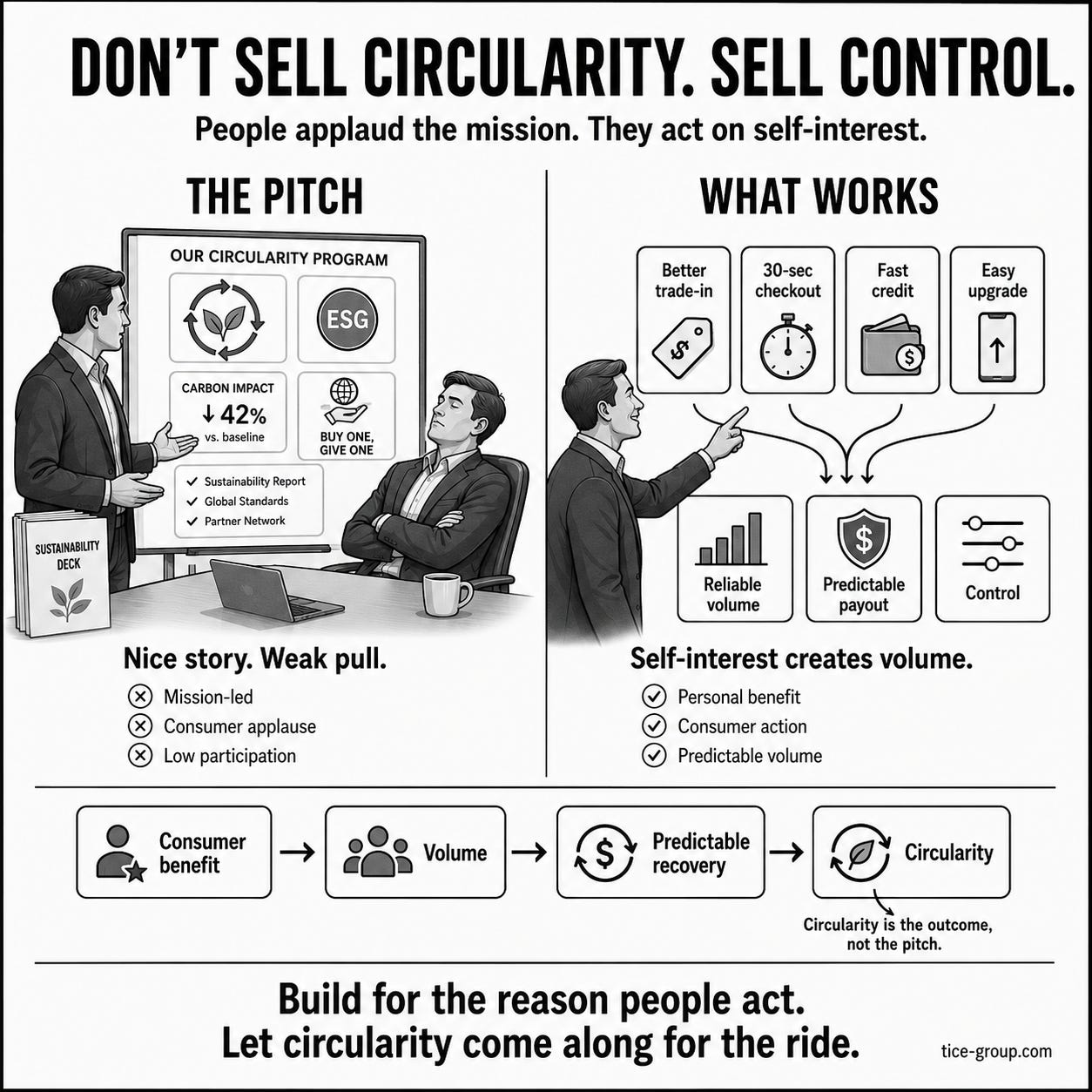
I was running US recovery programs while some of these models came through, and the pattern was hard to miss. Even a few years back, at the peak of the green moment when every survey said consumers cared about sustainability, their wallets were saying something quieter and, frankly, far more consistent: I act when there’s something in it for me. People have always behaved this way. They will tell you the planet matters, and they mean it, and then they will pick the option that puts cash or convenience in their pocket. Build a program that asks them to participate for the planet’s sake and you get applause and empty intake bins.
So circularity cannot be the program. It can only be a side effect of one. The programs that actually move volume are built around something the consumer wants for themselves: real money for the old device, a painless upgrade, a trade-in that clears in days instead of turning into a dispute. Get that right and the circularity happens anyway, quietly, as the byproduct of people acting in their own interest. Lead with the byproduct and the bins stay empty however good the slide looks; they fill only when there’s something in it for the person standing at the counter.
Let me give you the cleanest version of the mistake, because it came to me as a genuinely lovely idea. A partner once walked in with this: every time a customer trades in or buys a new phone, we give a working phone to someone who needs one in Africa. Buy one, give one. It is the kind of thing you want to say yes to in the room.
Then you start running the tape. The operations are not simple (sourcing, refurbishing, shipping, customs, making sure the donated device actually works once it lands). The economics are not simple either: somebody pays for all of that, and it is usually the same margin that was supposed to make the program survive. And then you reach the only question that decides whether any of it matters, which is what the customer does when they hear the pitch. The honest answer, over and over, was some version of “that’s cute, but I don’t really care.” Not contempt on their part, just a customer who’d been handed no reason to act on their own account. The cause did not move the behavior, and on its own it never does.
Now compare that to the thing that does move behavior: a better number on the trade-in, a checkout that takes thirty seconds, a credit that lands before the new phone ships. Boring and self-interested - and it works every time, in a way the give-one-to-Africa story never did. (For what it’s worth, the giving version can absolutely exist: as a quiet layer on top of a program people already use for their own reasons, never as the reason they show up.)
That is the ground floor: the consumer. Now follow the same logic one level up, to the brand or retailer who actually signs the contract. They are not buying a greener supply chain either, whatever the RFP says. They are buying a number they can predict and defend to their CFO: a payout window that holds, a grading standard that does not drift (the same device graded the same way every month), volume that shows up because their own customers genuinely want the deal. That predictability is the control they are paying for. Circularity is what goes in the annual report after the program already works.
The client’s control depends on volume, the volume depends on the consumer acting, and the consumer only acts on self-interest. So the program built on the consumer’s wallet is the same one that delivers the client’s predictability. Build it on the mission instead and both ends collapse: the consumer doesn’t show, the volume never materializes, and the number the client was promised turns into the write-off in month four. The build order is the whole trick: get the consumer’s number and the clearance speed right first, and the grading standard and payout window the client is buying tend to fall out of that, not the other way around.
The greenest programs I have seen ran on self-interest. Millions of people used them, devices moved, real circularity happened - quietly, as the byproduct of people chasing their own benefit. The virtue-led version of the same program, in the same market, with the same devices, recovered a fraction of that: a beautiful slide, and bins that never filled. If you genuinely care about the environmental outcome, the fastest way to get more of it is to stop asking the consumer to care and start giving them a reason to act. Turns out the planet gets more help from boring and self-interested than from beautiful and mission-first.
So the takeaway is not that consumers are selfish (and honestly, whether they are is beside the point), and it is certainly not “drop the mission.” It is this: build the program around a benefit the person has to act on for their own reasons, and let circularity be the compounding side effect it was always going to be.
There is a simple test for which one you’ve built. Strip every sustainability claim out of your consumer-facing pitch (every green logo, every carbon stat, the closed-loop diagram on the product page) and ask whether anyone would still use it. The reporting obligations stay; the question is whether the program survives without the mission as the hook. If the answer is yes, you have a program, and the circularity is safe because it rides on something durable. If the answer is no, you don’t have a program: you have a press release with an operations budget, and it is about to start bleeding money.
Don’t sell circularity: sell the thing your customer was always going to buy anyway, and let the planet come along for the ride.
About me: I’ve spent years building and scaling global trade-in and resale programs, first at Samsung, then at SquareTrade, and now as a founder. I launched the world’s first certified pre-owned phone program, built carrier and retailer trade-in systems, and ran recovery flows that unlocked hundreds of millions in value.
Execution Gaps is where I share the lessons I wish I had on day one: what breaks under stress, what actually holds, and the operating principles that separate them. Today I’m building TICE Group: not another vendor in the stack, but the orchestration layer that designs and operates recovery systems for brands and retailers - so more recovery lands in your pocket, without your team carrying the operational load.